What Is Surface Pattern Design? A Complete Beginner's Guide
Learn what surface pattern design is, how seamless repeats work, and what tools professionals use across fabric, wallpaper, packaging, and ceramics.
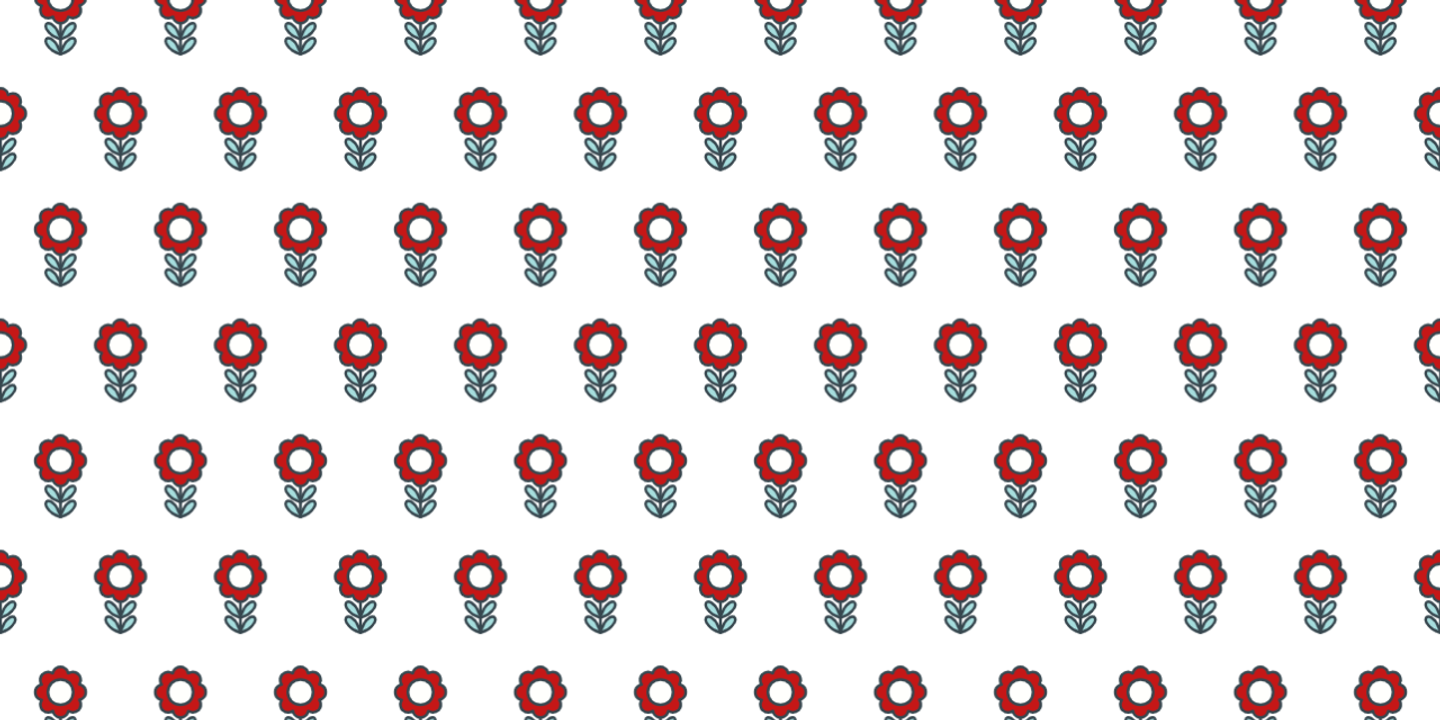
What Is Surface Pattern Design? A Complete Beginner's Guide
Surface pattern design is the practice of creating repeating decorative artwork applied to physical surfaces: fabric, wallpaper, ceramics, stationery, packaging. If you have ever bought a dress for its print, chosen wallpaper for its motif, or picked a notebook off a shelf because of its cover, a surface pattern designer made that choice happen.
This guide covers what surface pattern design actually is, how it works technically, who does it professionally, what tools they use, and how to start if you are coming from zero.
What surface pattern design actually means
The word "surface" is doing real work in that phrase. Surface pattern designers are not designing the structure of a fabric or the shape of a wallpaper panel. They design the decoration applied to that surface, the image layer on top.
That image layer has one unusual technical requirement: it has to repeat. A surface pattern is not a one-off illustration. It is a tile, a unit of artwork engineered to connect seamlessly with copies of itself, so the pattern can cover a tablecloth, a roll of wallpaper, or a bolt of fabric without ever showing where one tile ends and the next begins.
That is what separates surface pattern design from illustration, graphic design, or fine art. The technical constraint of seamless repetition is what makes it its own discipline.
Where surface patterns appear
Surface patterns are one of the most widespread forms of design in the world. You encounter dozens of them before you leave the house in the morning. They show up in more markets than most people realize.
Every printed garment starts with a repeat designed by a surface pattern designer. Fast fashion brands, luxury houses, and independent fabric makers all commission patterns regularly, often in high volume.
Wallpaper is one of the oldest markets for repeat patterns, with design traditions going back centuries. The contemporary market covers everything from maximalist botanical prints to quiet geometric linens.
Bedding, curtains, cushion covers, tea towels, bath mats. These are produced at massive scale. Pattern designers in this space need production-ready files that hold up at manufacturing volumes, which makes technical precision as important as the design itself.
The paper goods market is worth paying attention to if you are just starting out. Print runs can be smaller, licensing terms are often more accessible, and wrapping paper or greeting card deals can be a practical entry point into commercial work.
Tiles, plates, mugs, and other ceramic products use repeat patterns applied through transfer printing or glaze printing. The geometric constraints here differ from fabric because pattern scale relative to object size matters a lot. A repeat that works beautifully on a metre of fabric can look completely wrong wrapped around a mug.
Brands also use distinctive patterns as commercial assets. A luxury tea tin, a cosmetics brand's signature print you can identify from across a shop floor. Packaging is a serious and often overlooked market for surface pattern work.
The core technical skill: building a seamless repeat
The defining technical skill in surface pattern design is constructing a seamless repeat, a tile of artwork that joins invisibly with copies of itself on all sides.
This sounds straightforward. In practice it is one of those things that takes about five minutes to understand and years to execute well consistently.
When you place your tile to the right of itself, the right edge of the original must connect perfectly to the left edge of the copy. Same for top and bottom. If any motif crosses an edge, it has to be split at that edge and its continuation must appear at the opposite edge in exactly the right position, so the two halves rejoin when the tiles sit together.
This requirement flows through every design decision: the scale of the motifs, their placement, the density of the composition, the negative space. A motif that is slightly too large, slightly misplaced, or slightly misaligned will show a join. A professional seamless repeat has no join anywhere on the tiled surface at any scale.
The seven main repeat structures
Different repeat structures create different visual rhythms. These are the ones used most in professional production.
Full drop (straight repeat) is the simplest. The tile repeats identically in a straight grid. Joins occur at the same horizontal and vertical points throughout. It tends to create a structured, formal feel and is easy to construct.
Half drop shifts each successive column of tiles down by half the tile height. This breaks the grid feeling and adds diagonal movement to the pattern. Half drop is one of the most common structures in fabric design because it feels dynamic without being complicated to produce.
Brick repeat shifts each successive row horizontally by half the tile width, like a brick wall. It creates a horizontal rhythm and works well for geometric and stripe-adjacent designs.
Mirror repeat reflects the tile, horizontally, vertically, or both, before repeating. It creates strong symmetry and is common in geometric, damask, and traditional patterns.
Diamond repeat rotates the tile 45 degrees and repeats it in a diagonal grid. The result is an elegant, formal rhythm — you see it throughout heritage textile traditions and classical wallpaper for a reason.
Ogee uses a curved, pointed arch shape as the repeat unit. It has strong vertical emphasis and shows up constantly in historical textiles and wallpaper. Once you know the shape you start seeing it everywhere.
Tossed (or random) repeat scatters motifs irregularly across the tile rather than arranging them in a structured composition. The repeat unit still tiles seamlessly, but the result feels organic and casual rather than rhythmic. Good for designs where you want the pattern to feel hand-placed.
The anatomy of a surface pattern
A surface pattern has three main components. Understanding all three is what separates a professional designer from someone who knows how to make something look good but struggles to make it work commercially.
The motif
The motif is the individual design element: one flower, one geometric shape, one illustrated leaf. A pattern can be built from a single motif repeated identically, or from a collection of related motifs arranged together in a composition.
The quality of the motif determines the quality of the pattern. Motifs that read clearly at multiple scales, have strong silhouettes, and hold up at the repeat join are the ones that make strong patterns. Most beginners underinvest in the motif and pay for it at the repeat stage.
The ground
The ground is the background, the space between and behind the motifs. It is not passive. Its color, texture, and relationship to the motifs determines whether the pattern feels light or heavy, maximalist or restrained, traditional or contemporary.
Designers talk about positive and negative space in pattern exactly the way they do in any visual discipline. In surface pattern specifically, the ground has to work across the full repeat unit in a way that supports rather than fights the seamless join. A ground that works fine in isolation can create a very obvious grid when the tile repeats.
The colorway
A colorway is a specific palette applied to the repeat structure. Most commercial patterns are produced in multiple colorways: the same repeat in navy and cream, in dusty rose and sage, in charcoal and gold. This lets buyers choose the palette that fits their product line without commissioning a new design from scratch.
Managing colorways is one of the more technically demanding parts of production work. A client requesting six colorways across a twelve-design collection means the workflow needs to be systematic. This is exactly where parametric design tools create real time savings over manual recoloring in traditional software.
Who works in surface pattern design
The industry is bigger than most people expect, and the career paths into it are more varied than a single job title suggests.
Large fabric mills, wallpaper companies, home decor brands, and fashion houses employ pattern designers in-house. These roles involve working to a brief, producing designs in volume, and managing tight handoff timelines for production. The work is less creatively autonomous but more stable.
Freelance designers work on commission. A client, a clothing brand, a stationery company, a tile manufacturer, commissions a collection for a specific season or product line. The designer produces the work, hands over the files, and is paid per design or per project.
Licensing is a different model entirely. A designer creates a pattern on spec and licenses the right to manufacture it to a client. The designer keeps ownership and earns royalties every time the pattern goes into production. A well-placed design can generate royalties across multiple product categories and territories simultaneously. That scalability is why licensing is what most independent designers are working toward.
Print-on-demand platforms like Spoonflower, Redbubble, and Society6 let designers sell products printed from their patterns directly to consumers, without managing inventory or production. The entry cost is low. Building meaningful revenue takes longer.
The tools surface pattern designers use
Adobe Illustrator
The industry standard for vector-based pattern construction. Illustrator's Pattern Options panel lets designers build seamless repeats inside the application, though many professionals supplement it with manual repeat construction techniques for more control over complex compositions.
The honest limitation: Illustrator is a general-purpose design tool. Its pattern workflow was not designed for production surface design. Building multiple colorways, managing large collections, and exporting production-ready bundles are all manual, time-consuming processes. Designers working at volume often spend more time in Illustrator's file management than in its creative tools.
Adobe Photoshop
Used for hand-painted, textured, or photographic patterns where a raster (pixel-based) approach fits the aesthetic better. Photoshop's Offset filter is the traditional method for constructing seamless repeats from raster artwork.
Procreate
Widely used for sketching and developing motifs, particularly among illustrative designers who start with a hand-drawn or painted aesthetic. Procreate has basic pattern repeat tools, but most designers move work into Illustrator or a dedicated platform for the final production repeat.
Parametric design platforms
This is a newer category: purpose-built tools for surface pattern design where the repeat logic is handled by the software rather than the designer. Instead of manually placing and aligning repeat elements, the designer sets parameters (repeat type, scale, density, rotation) and the system generates the repeat automatically.
Motifos is built in this category, specifically for designers and studios working at production scale: large collections, multiple colorways, precise file specifications, and fast iteration. The parametric approach removes the most repetitive parts of the repeat-building workflow, which is where most production time actually disappears.
What "production ready" means
A pattern file that looks correct on screen is not automatically a production-ready file. Production readiness means the file meets the technical specifications of the manufacturing process it is going into. Getting this wrong costs time and sometimes money.
Resolution is where beginners most often get caught out. Fabric and wallpaper printing typically requires a minimum of 150 DPI at print size for most processes, and 300 DPI for high-definition digital printing. A file that looks sharp on a monitor at 72 DPI will print soft and blurry at production scale.
Color mode matters more than most designers expect. Screens use RGB. Most print processes use CMYK, or specify Pantone colors for exact color matching. A pattern designed in RGB and sent to a printer without color conversion will shift in hue, sometimes noticeably, sometimes dramatically.
Repeat size has to match the printing process. Rotary printing for fabric has specific repeat circumference constraints determined by the roller size. Wallpaper is printed in defined panel widths. Getting the repeat dimensions wrong means the file cannot be used without rework.
File format is the final piece. SVG and EPS for vector-based designs. TIFF at 300 DPI for raster. PDF for client proofing. The right format depends on the output process. Sending the wrong one adds steps to the production chain and signals inexperience to the manufacturer.
How to start learning surface pattern design
Before worrying about aesthetics, understand how a seamless repeat is constructed. Build one manually in whatever software you have access to, even a simple geometric tile. The goal is not to make something beautiful. The goal is to understand why the edges have to match and how motif placement at the border of the tile works. Do not skip this step.
Look at professional surface patterns and analyze them actively, not passively. What repeat type is being used? How densely are the motifs placed? How does the ground interact with the motifs? What scale is the repeat relative to the product it appears on? This kind of looking builds pattern recognition that is genuinely impossible to develop any other way.
Most beginners try to design the repeat and the motif at the same time. This usually produces weak results on both. Develop motifs with strong individual character first. Then figure out how they repeat. The repeat is just the vehicle.
A single pattern is a sample. A collection, four to six designs with a shared color palette, scale variation, and visual coherence, is what clients and buyers evaluate. The transition from making individual patterns to designing coherent collections is where this starts to become a professional practice rather than a hobby.
Learn the production requirements of your target market before you need them urgently. Fabric for fashion has different technical requirements from wallpaper, from home textiles, from paper goods. Knowing the resolution, color mode, file format, and repeat size specifications for your market is not optional. It is the difference between a file that goes straight to manufacturing and one that gets sent back for revisions.
Surface pattern design and parametric tools
The skills described above, building seamless repeats, managing colorways, producing to specification, have been manual processes for most of the industry's history. A designer producing a collection of 12 designs in 6 colorways would spend a large portion of their time on technical repeat construction and file preparation rather than on design decisions.
Parametric tools change this by encoding the repeat logic into the software. The designer specifies the parameters (repeat structure, tile size, motif scale and rotation, color palette) and the system handles the geometry. Colorways become a parameter change rather than a manual recoloring job. Exporting at the correct resolution, in the correct format, with the correct repeat dimensions becomes a single action rather than a multi-step process.
This does not remove design skill. The quality of the motifs, the compositional judgment, the color sensibility: these remain entirely the designer's domain. What parametric tools remove is the technical overhead that sits between a design decision and a production-ready file.
For studios working at volume, the time difference is real enough to change what is commercially possible within a given production cycle.
The skills that make a great surface pattern designer
Technical competence with repeat construction and file production is table stakes. The work that actually matters starts after that.
Compositional instinct matters more than most beginners expect. Arranging motifs within the repeat tile so the overall pattern has rhythm, balance, and visual movement is not about symmetry. It is about controlling the eye across a tiled surface that the viewer will see in its repeated form, not as a single tile.
Color intelligence separates good designers from great ones. Surface patterns live or die by color. This includes understanding color relationships within a colorway, how colors shift under different lighting conditions, how commercial color systems (Pantone, CMYK) relate to what you see on screen, and how to build colorway palettes that work as a set rather than just individually.
Scale awareness is underestimated by almost everyone who is new to this. A pattern that looks balanced at a small thumbnail can feel overwhelming at actual product scale. Professional designers constantly test their work at the scale it will actually be experienced by the person buying the product.
Production knowledge builds professional trust faster than portfolio quality alone. Designers who hand over files that go straight to production without revision requests get rehired. Clients notice this faster than you might expect.
Range helps commercially. Designers who can work across styles, scales, and aesthetic registers have a wider commercial footprint. That said, a distinctive personal style is also commercially valuable, sometimes more so. Some of the most successful licensing designers have an immediately recognizable visual voice that is worth more than versatility.
What to expect when you start
The first seamless repeat you build will probably have a visible join somewhere. The first collection will probably feel inconsistent. The first time you hand off a production file, you will probably miss something.
Everyone does. The designers who make this look effortless developed that eye over years of tiling their work and catching problems before a manufacturer did. They did not start with it.
The feedback loop in surface pattern design is faster than in most design disciplines. Build a repeat, tile it, see where it breaks. Design a collection, put it in front of people, see what holds. The discipline is honest about what is working and what is not, which is actually useful when you are learning.
Digital printing has made smaller runs economically viable and opened up markets that did not exist a decade ago. If you are taking this seriously, the timing is not bad.
Summary
Surface pattern design is the discipline of creating repeating decorative artwork applied to fabric, wallpaper, ceramics, stationery, and a broad range of other surfaces. Its defining technical requirement is the seamless repeat, a tile of artwork that connects invisibly with copies of itself in all directions.
The main repeat structures are full drop, half drop, brick, mirror, diamond, ogee, and tossed. The three components of a surface pattern are the motif, the ground, and the colorway.
Professional surface pattern designers work in-house at studios and manufacturers, as commissioned freelancers, through licensing arrangements, and through direct-to-consumer platforms. The tools range from Adobe Illustrator and Photoshop to Procreate to parametric platforms built for production-scale pattern work.
Production readiness (correct resolution, color mode, file format, and repeat dimensions for the specific manufacturing process) is as important as the design itself.
The skills that matter most beyond technical competence are compositional instinct, color intelligence, scale awareness, and production knowledge.
Motifos is a parametric pattern design platform built for professional surface designers and studios. It handles the geometry of seamless repeat construction automatically, so you can focus on the design rather than the technical overhead. Try Motifos free
Frequently Asked Questions
What is surface pattern design?
Surface pattern design is the practice of creating repeating decorative motifs applied to physical surfaces: fabric, wallpaper, ceramics, packaging, and stationery. A surface pattern designer arranges colors, shapes, and textures into a composition that tiles seamlessly across any area.
What is the difference between surface pattern design and textile design?
Textile design focuses specifically on patterns for woven, knitted, or printed fabrics, and often involves understanding how thread structure affects the final result. Surface pattern design is broader. It covers all surfaces, including wallpaper, ceramics, paper goods, and digital interfaces, not just fabric.
What is a seamless repeat in pattern design?
A seamless repeat is a tile of artwork where copies placed side by side, horizontally and vertically, connect with no visible join. The result is a pattern that covers any size surface without seams or breaks.
What software do surface pattern designers use?
Professional surface pattern designers commonly use Adobe Illustrator for vector-based repeats, Photoshop for painterly textures, and Procreate for sketching motifs. Parametric platforms like Motifos are used in production workflows where precision, speed, and automated repeat generation matter.
What are the main types of pattern repeats?
The seven main repeat types in professional surface design are: full drop (straight), half drop, brick, mirror, diamond, ogee, and tossed (random). Each creates a different visual rhythm. Half drop adds diagonal movement, mirror creates symmetry, and tossed feels organic and relaxed.
Can you make a living as a surface pattern designer?
Yes. Surface pattern designers work in-house at fabric mills, wallpaper studios, home decor brands, and fashion companies, or freelance and license their designs to multiple clients. Licensing, where a single design earns royalties each time it is manufactured, is the primary income model for independent designers.
What is the difference between a motif and a pattern?
A motif is a single design element: one flower, one geometric shape, one illustrated bird. A pattern is what you get when a motif is arranged and repeated across a surface using a repeat structure. The motif is the ingredient; the pattern is the dish.
What file formats do surface pattern designers use for production?
SVG and EPS are the standard vector formats for scalable patterns used in fabric and wallpaper printing. PNG and TIFF are used for raster exports at high resolution (300 DPI minimum for print). PDF is common for client proofing. Production studios increasingly request repeat-ready bundles containing all colorways.
How is surface pattern design different from graphic design?
Graphic design creates compositions for fixed-size outputs: a poster, a logo, a website layout. Surface pattern design creates compositions that repeat infinitely across variable surfaces. The core technical skill, building seamless repeats that tile without visible joins, has no direct equivalent in general graphic design.
What is a colorway in surface pattern design?
A colorway is one version of a pattern in a specific set of colors. A single repeat structure is typically produced in multiple colorways so buyers can choose the palette that fits their collection without redesigning the pattern from scratch.